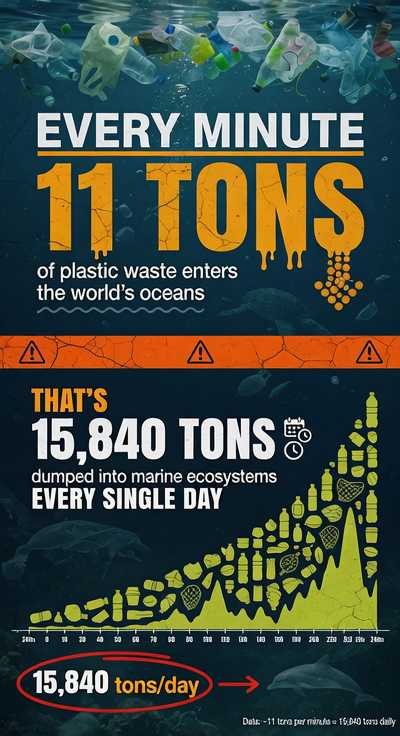
Every minute, more than 11 tons of plastic waste flow into the world’s oceans. Put another way:
That single calculation is more than arithmetic; it is a measure of a global system failing to contain the waste it produces. The plastics we discard do not vanish. They persist, fragment into microplastics, move through food webs, and reshape coastlines, fisheries and human health in ways we are only beginning to understand.
The scale and stakes
What 15,840 tons a day looks like. Imagine thousands of garbage trucks unloading at the shoreline every 24 hours. Imagine packaging, single‑use items, industrial pellets, and lost fishing gear accumulating faster than communities can collect and process them. Over months and years, that daily flow becomes a permanent load on marine ecosystems.
Why it matters. Plastics are durable by design. In the ocean they break into ever‑smaller particles that are eaten by plankton, fish and shellfish, and that travel into sediments, the deep sea and the atmosphere. The ecological consequences include entanglement and ingestion by wildlife, disruption of habitats, and the spread of invasive species on floating debris. The human consequences include contamination of seafood and coastal environments, economic losses for fisheries and tourism, and potential health risks from chemical additives and microplastics.
How we got here: a system built for disposability
The flow of plastic into the sea is not a single failure but a cascade of design, policy and infrastructure gaps:
- Production and design choices favor low cost and convenience over durability and recyclability.
- Global waste systems are uneven: many regions lack reliable collection, sorting and disposal.
- Market incentives reward cheap virgin plastic and make recycling economically marginal.
- Regulatory gaps allow plastic production and single‑use culture to expand faster than mitigation efforts.
Fixing the problem requires shifting the system at every stage of a product’s life cycle — from design and production to consumption and disposal.
What governments can do — policy levers that change the math
1. Regulate the full lifecycle of plastics Adopt laws that require manufacturers to design for reuse and recyclability, limit toxic additives, and report material flows. Lifecycle regulation shifts responsibility upstream and reduces the volume of problematic waste.
2. Implement Extended Producer Responsibility (EPR) Make producers financially and operationally responsible for collection, sorting and end‑of‑life management. EPR creates incentives to reduce packaging, invest in reusable systems and fund local waste infrastructure.
3. Phase out avoidable single‑use plastics Use targeted bans, phased restrictions and time‑limited exemptions to remove the most harmful items (e.g., certain single‑use bags, cutlery, and polystyrene food containers) while ensuring affordable, accessible alternatives.
4. Invest in waste collection and processing infrastructure Prioritize funding for curbside collection, transfer stations, material recovery facilities and safe disposal in regions with high leakage. Infrastructure investments must be paired with workforce training and transparent performance metrics.
5. Strengthen international cooperation and river‑to‑sea interventions Support binding international agreements that set reduction targets, harmonize standards, and fund river‑basin interventions to intercept plastics before they reach the ocean.
6. Use public procurement to create markets Governments can drive demand for reusable, repairable and recycled products by making sustainability a procurement requirement for public services and infrastructure.
7. Tackle fishing gear and maritime sources Mandate gear marking, incentivize gear retrieval programs, and require port reception facilities for lost or damaged gear to reduce one of the most damaging ocean inputs.
8. Fund research, monitoring and transparent reporting Support standardized monitoring of plastic flows, ecological impacts and human exposure, and require public reporting so policy can be evidence‑based and adaptive.
What individuals and communities can do — high‑leverage actions
1. Reduce and refuse first The single most effective step is to reduce demand: carry a reusable bottle and bag, avoid single‑use packaging, and choose products with minimal or recyclable packaging.
2. Choose durable and repairable goods Buy less, buy better, and prioritize products designed to last. Repair and reuse extend product lifetimes and reduce waste generation.
3. Support circular business models Subscribe to refill services, buy from brands that offer take‑back programs, and favor companies that disclose material sourcing and end‑of‑life plans.
4. Dispose responsibly and push for better local services When disposal is necessary, follow local sorting rules, avoid littering, and advocate for improved municipal collection and recycling services.
5. Organize and participate in local cleanups with a purpose Beach and river cleanups raise awareness and remove debris, but they are most effective when paired with advocacy for upstream prevention and better waste systems.
6. Vote and hold institutions accountable Support policies and candidates that prioritize waste reduction, infrastructure investment and corporate accountability. Pressure brands to publish material flows and reduction targets.
7. Educate and amplify Share clear, evidence‑based information about plastic impacts and practical alternatives. Community education changes norms and consumer expectations.
Technology and innovation — tools, not silver bullets
Technological advances can help, but they are not a substitute for policy and behavior change:
- Better materials (biobased or truly compostable polymers) can reduce persistence when they are used in appropriate contexts and disposed of correctly.
- Improved recycling technologies (chemical recycling, advanced sorting) can increase recovery rates but must be evaluated for energy use, emissions and real circularity.
- Interception systems in rivers and coastal areas can capture plastics before they reach the open ocean, buying time while upstream solutions scale.
Technology must be deployed within a framework that prioritizes reduction and redesign first, then recovery and remediation.
Equity, trade‑offs and unintended consequences
Policy choices carry trade‑offs. Bans without affordable alternatives can burden low‑income households. Recycling targets without collection systems can create false confidence. New materials can introduce new environmental or health risks if not carefully assessed. Effective solutions must be equitable, context‑sensitive and accompanied by social supports and infrastructure investments.
Measuring success — what to track
To know whether interventions work, governments and communities should track:
- Mass of plastic entering waterways and the ocean (annual and seasonal trends).
- Collection and recycling rates by material type.
- Production volumes of virgin plastic and the share of recycled content.
- Incidence of plastic in key species and seafood (ecological and human exposure indicators).
- Economic indicators such as jobs created in reuse and recycling sectors and costs avoided by reduced cleanup.
Transparent, comparable metrics enable accountability and course correction.
A practical, phased plan for the next five years
Year 1–2: Stop the worst leaks
- Tax or restrict the most problematic single‑use items.
- Launch national EPR frameworks and pilot river interception projects.
- Fund rapid expansion of basic collection services in high‑leakage regions.
Year 3–4: Scale systems and markets
- Use procurement to scale reusable systems and recycled content markets.
- Invest in advanced sorting and targeted recycling for hard‑to‑recycle streams.
- Expand public education and business transition support.
Year 5: Lock in circularity
- Achieve measurable reductions in plastic leakage and virgin plastic production.
- Institutionalize monitoring and international cooperation.
The moral and practical imperative
The figure 15,840 tons per day is a blunt instrument of truth: it tells us how much material we are failing to manage, and it points to where action must be concentrated. The solutions are not purely technical; they are political, economic and cultural. They require governments to set rules and invest, companies to redesign and take responsibility, and citizens to change habits and demand better.
This is not a problem that will be solved by a single law, technology or cleanup campaign. It will be solved by a sustained, coordinated shift in how we design, buy, use and manage the things we make. The ocean is not a trash can; it is the planet’s circulatory system. Protecting it protects fisheries, livelihoods, coastal communities and, ultimately, our own health.
What you can do today
- Carry a reusable bottle and bag.
- Refuse single‑use cutlery and straws.
- Choose products with minimal packaging.
- Join or support local groups pushing for better waste services.
- Ask your representatives to back EPR, infrastructure funding and procurement rules that favor reuse.