The “Wemby Show”: Why NBC’s Overwhelming Playoff Coverage Faces a Fairness Problem
The 2026 Western Conference Finals between the San Antonio Spurs and the Oklahoma City Thunder delivered historic drama, a thrilling seven-game arc, and record-breaking television ratings. Yet, for many basketball purists tuning into NBC and Peacock, the series felt less like a clash between two elite powerhouse teams and more like a singular reality show: The Victor Wembanyama Story.
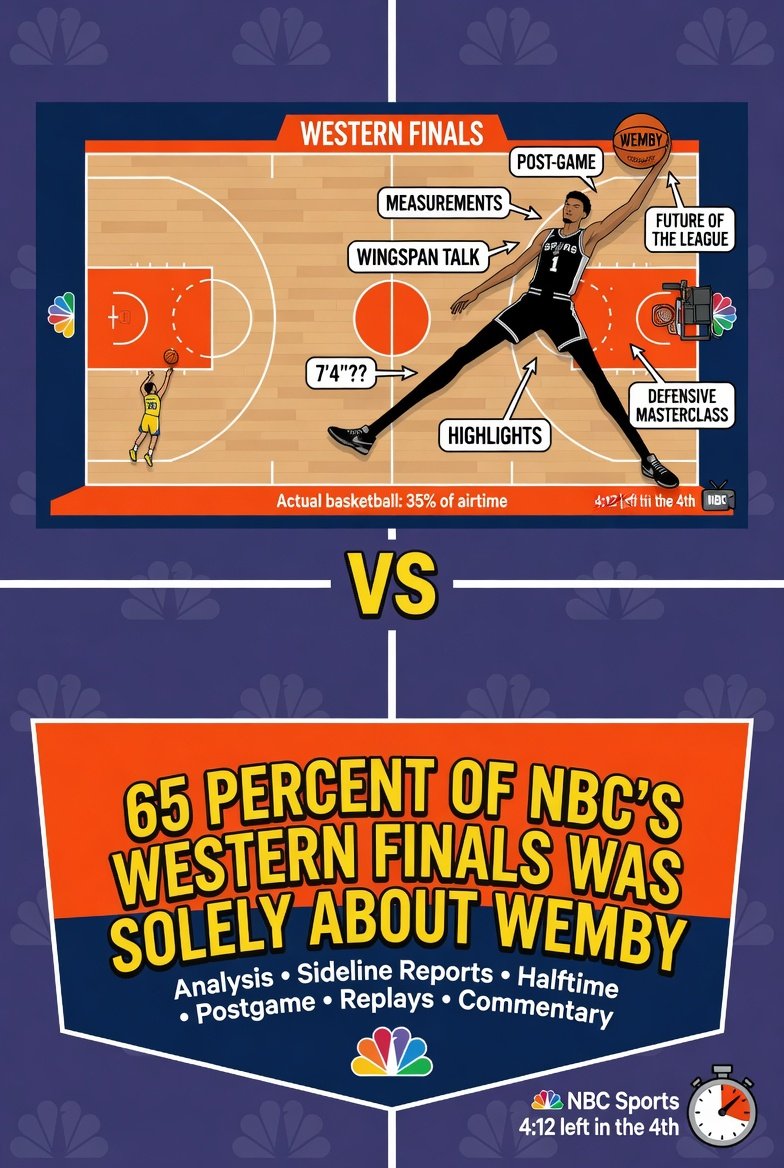
Sports media analysts estimate that a staggering 60% to 65% of the total broadcast content—ranging from Mike Tirico’s in-game commentary to isolated camera cuts and studio graphics—was centered entirely on San Antonio’s 7-foot-4 phenom. Instances included cutting away from live game coverage to show Wemby cycling on a bike, to showing his monk-like outfits. While Wembanyama’s legendary Game 1 stat lines and dramatic Game 4 buzzer-beater undoubtedly earned the spotlight, the sheer density of the “Wemby Effect” coverage highlights a growing problem [1]. It is time for the NBA and its broadcast partners to implement a more balanced blueprint for national television.
The Cost of Single-Player Hyper-Focus
By transforming a team sport into a one-man narrative, the broadcast structure actively shortchanged both the victor and the vanquished:
- Diminishing a Historic Opponent: The Oklahoma City Thunder entered the series boasting a two-time defending league MVP in Shai Gilgeous-Alexander. Yet, Thunder possessions were routinely framed not by their own offensive brilliance, but merely by how they reacted to Wembanyama’s defensive radius.
- Erasing Team Context: Basketball is a game of depth. Highlighting Wembanyama at the expense of crucial supporting cast storylines strips away the tactical nuance that makes a seven-game playoff series a masterpiece.
Why Balance is Better for Business
NBC naturally followed the numbers; the network announced that the series pulled a historic 10.3 million viewers, openly crediting Wembanyama for the economic boom. However, hyper-focusing on a single superstar is a short-sighted strategy.
When a network builds 75% of its studio pregame and halftime coverage around one individual, it fails to educate casual viewers on the rest of the league’s stars. If Wembanyama’s team is ever eliminated early in future seasons, casual fans will have little incentive to stay tuned because the broadcast failed to invest in the narratives of opposing players.
A Call for Modern Broadcast Reform
To foster long-term league growth, NBC and the NBA should establish baseline coverage guidelines that ensure equitable storytelling. A fair broadcast doesn’t mean ignoring a generational talent—it means contextualizing them within a competitive landscape. Producers must allocate dedicated graphic packages and replay sequences to both sides of the ball, forcing talking heads to analyze the chess match, not just the king.
The NBA’s future is incredibly bright, filled with a deep pool of diverse international talent. It is time for national broadcasts to start treating it like a league of superstars, rather than a league of one.